
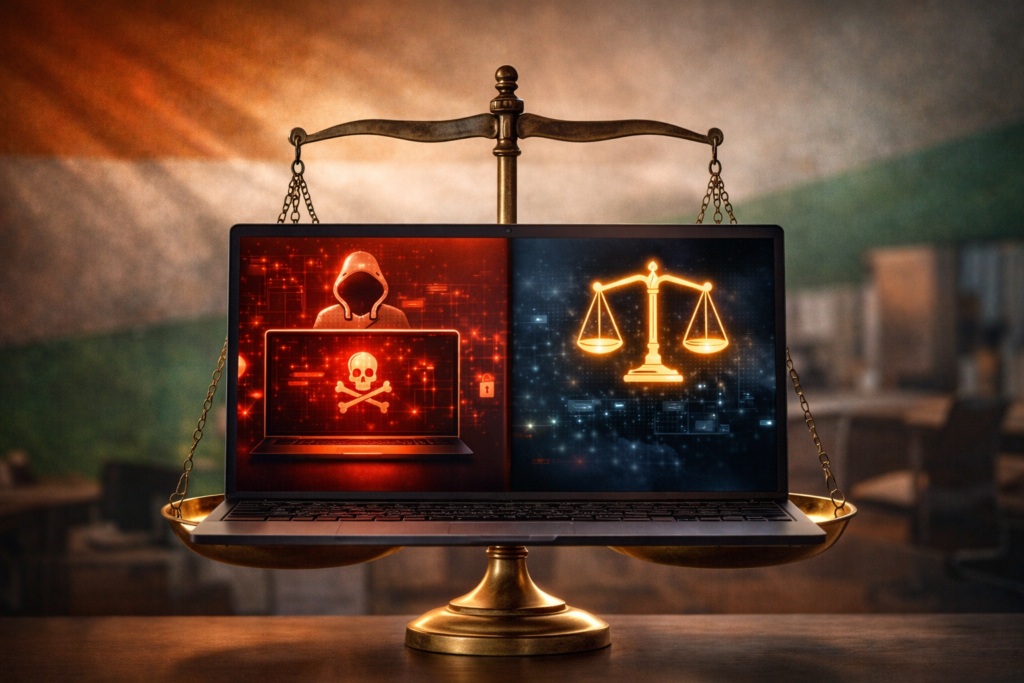
If you ask people what cyber crime means, most answers are pretty quick.
Something like… hacking, scams, online fraud.
That’s not wrong. But when you look at it from a legal point of view in India, it’s not that straightforward.
There isn’t just one simple definition sitting somewhere that explains everything.
Instead, the law looks at different kinds of actions—what exactly was done, whether there was permission, and what the impact was.
Most of this comes under the Information Technology Act, 2000. That’s what usually applies in cyber-related cases.
It’s Not Always About “Hacking”
People often think cyber crime starts only when someone breaks into a system.
But the law doesn’t always look at it that way.
Even accessing something without permission can be enough. No damage, no big change—just access.
In real situations, that could be using someone else’s login, opening files you weren’t supposed to, or entering a system without proper rights.
It may not feel serious at that moment.
But legally, it can still matter.
Data Is Where Things Get Sensitive
A lot of things under the IT Act come back to data.
Who accessed it, who copied it, who shared it.
If someone takes data without permission—even just to “look at it”—that can become an issue.
The tricky part is that in everyday work, data is constantly moving.
Files get downloaded. Documents get shared. Links get forwarded.
Most of the time, it feels normal.
But not every action is actually allowed.
Pretending to Be Someone Else
Another area that comes up quite often is impersonation.
Fake emails, fake profiles, messages that look like they’re from someone you know—these things are very common now.
And they don’t always look fake.
Under the IT Act, this kind of behaviour is taken seriously, especially if it leads to confusion, misuse, or financial loss.
Even creating a situation where someone trusts the wrong identity can be enough.
What People Share Online
Then there’s the content side.
What gets posted, forwarded, or shared.
Sometimes people don’t think much before sending something along—especially on WhatsApp or social media.
But if something is shared without consent, or if it crosses certain limits, it can become a legal issue.
That part surprises a lot of people.
Why It Feels Complicated
Honestly, one reason this topic feels confusing is because the law doesn’t explain things the way people normally talk.
It doesn’t say things in simple “right or wrong” terms.
It focuses on actions—unauthorized access, misuse of data, identity issues.
So something that feels small or harmless in real life might still fall under one of those categories.
It’s Not Just One Law Working Alone
Another thing people don’t always realize—
the IT Act is not the only law involved.
If a situation includes fraud, cheating, or financial loss, other laws can also apply at the same time.
So one incident can be looked at from different legal angles.
Why This Actually Matters
Most cyber issues don’t start with intention.
Nobody usually thinks, “I’m doing something illegal.”
It’s often just a quick action. Clicking something. Sharing something. Using access without thinking much about it.
That’s how it usually begins.
Which is why understanding the basics helps—not in a technical way, just in a practical sense.
Final Thoughts
Cyber crime under the IT Act isn’t one single thing.
It’s more like a collection of different situations that all connect to how systems and data are used.
Some are obvious. Some are not.
And as more of everyday life moves online, these situations come up more often than people expect.
Knowing where the line is—even roughly—can make a big difference.