
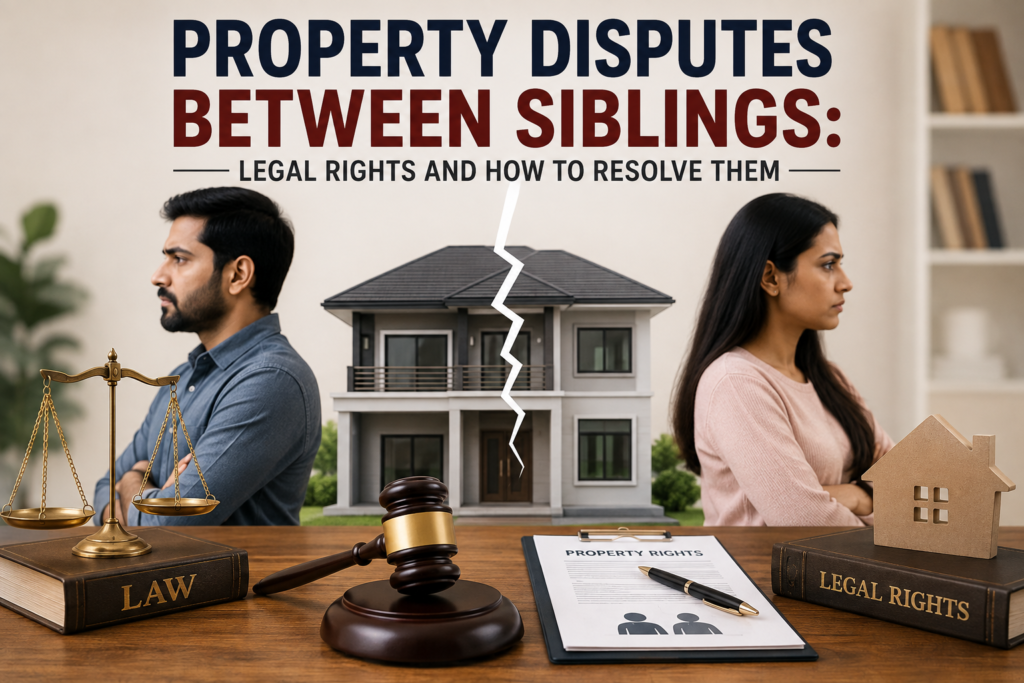
A client walked into my office last month. He was in his mid-forties. Before he even sat down, he said, “Sir, my brother has put a lock on our father’s house. I grew up there. Now I’m not even allowed inside.”
There wasn’t much anger in his voice. Just exhaustion.
That’s the story behind most sibling property disputes I’ve seen. The pain of a broken relationship usually outweighs the value of the property itself.
Property disputes between siblings are among the most common cases a family lawyer in India handles. And more often than not, they drag on longer than they need to. Why? Because people don’t fully understand their own legal rights.
Is the Property Ancestral or Self-Acquired?
Nothing about a property dispute makes sense until this distinction is clear.
Ancestral property is property that has passed down undivided through four generations. It moves from father to grandfather to great-grandfather.
Every coparcener has a right in it by birth. After the Hindu Succession (Amendment) Act, 2005, this includes sons and daughters equally. Nobody needs to “give” you a share. It exists the moment you’re born into the family.
Self-acquired property is different. It’s something a person bought or earned through their own effort. The owner has full control over it.
They can leave it to one child through a will. They can even leave it to someone outside the family. Only when there’s no will do succession laws step in. Then the property is divided equally among the legal heirs.
Most disputes start right here. Families often assume, “It’s our father’s house, so it must be split equally.” But in reality, how the property was acquired changes everything.
The Confusion Around Daughters’ Rights
Even today, many families believe something incorrect. They think that once a daughter marries, she loses her claim over family property.
That’s simply not true.
After the 2005 amendment, daughters are coparceners. They stand on exactly the same footing as sons. This applies no matter when they got married. It applies even if they never raised the issue before.
In 2020, the Supreme Court made this even clearer. In Vineeta Sharma v. Rakesh Sharma, the court ruled that this right exists by birth. It doesn’t depend on whether the father was alive in 2005.
So if a sister is told she “already got her share through marriage,” that argument doesn’t hold up. Not legally.
How Property Actually Gets Divided
There are three common paths. Each works differently, depending on how much the siblings can agree.
Family Settlement: The Simplest Route
If siblings can sit down and agree, a family settlement deed is the best option. It avoids court entirely. It saves time. And it keeps the relationship somewhat intact.
The key step? Get the deed properly drafted, stamped, and registered. This way, no one can walk back on it later.
Partition Suit: When Agreement Isn’t Possible
Sometimes, conversation fails. When that happens, the next step is a partition suit in civil court.
The court decides each heir’s rightful share. If the property can’t be physically divided — a single house, for example — the court can order it sold. The proceeds are then split.
This is usually the path families take when one sibling takes possession and locks the others out. Just like the brother in my client’s case.
Mediation: A Middle Ground
Many family courts now push for mediation first. A neutral third party hears both sides. They work toward a settlement together.
Mediation is faster than a partition suit. And because it’s less adversarial, it tends to do less damage to the relationship.
A Few Practical Things That Actually Help
Here’s what I tell every client dealing with a property dispute:
- Don’t wait too long to act if one sibling has taken sole possession. The longer you delay, the harder it becomes to challenge that possession later.
- Never rely on a verbal understanding. No matter how close the family is, every agreement should be in writing and registered.
- Send a legal notice first. Sometimes that alone brings the other side to the table, without going to court.
- Check whether a will actually exists. Many disputes come down to whether a will is genuine, and when it was made.
In the End
Property disputes are rarely just about money. They’re fights between people who once grew up under the same roof.
The law is clear about who is entitled to what. But here’s the truth: the earlier you get the right advice, the less damage is done. Both to the property’s value, and to the relationships involved.
Is your family caught in a similar situation? The first step is simple. Get your case reviewed by an experienced property lawyer, before it escalates into something only a courtroom can resolve.