For a long time, data protection penalties in India felt distant.
They existed on paper.
They were discussed at conferences.
Yet, they rarely changed how businesses actually behaved.
That situation has now changed.
The Digital Personal Data Protection (DPDP) Act, 2023 fundamentally alters the risk equation. It introduces penalties that are neither symbolic nor optional. More importantly, these penalties do not soften based on company size or intent.
For the first time, Indian law places a direct financial cost on treating personal data casually.
Why the DPDP Penalty Framework Matters
The DPDP Act does not impose penalties for punishment alone. Instead, it focuses on correction through consequence.
Until now, many organizations approached data protection as a compliance checkbox. This approach survived because the downside of getting things wrong was limited. However, the DPDP Act removes that comfort entirely.
Under the new framework, penalties are designed to:
Reflect the seriousness of the harm caused
Scale with the nature and impact of the violation
Force attention at the board and leadership level
Change incentives, not just surface-level behavior
As a result, compliance is no longer cheaper than non-compliance.
How DPDP Penalties Actually Work
Unlike older regulatory models, the DPDP Act does not follow a fixed “one violation, one fine” structure.
Instead, penalties are contextual. Authorities assess multiple factors before deciding the amount, including:
The nature and gravity of the violation
The duration of non-compliance
Whether the failure was negligent or intentional
Corrective steps taken after the issue surfaced
The real impact on affected individuals
Because of this approach, penalties are not automatic. However, they are very real and increasingly difficult to avoid.
The Highest Risk: Failure to Protect Personal Data
The most severe penalties under the DPDP Act arise from failures in data security.
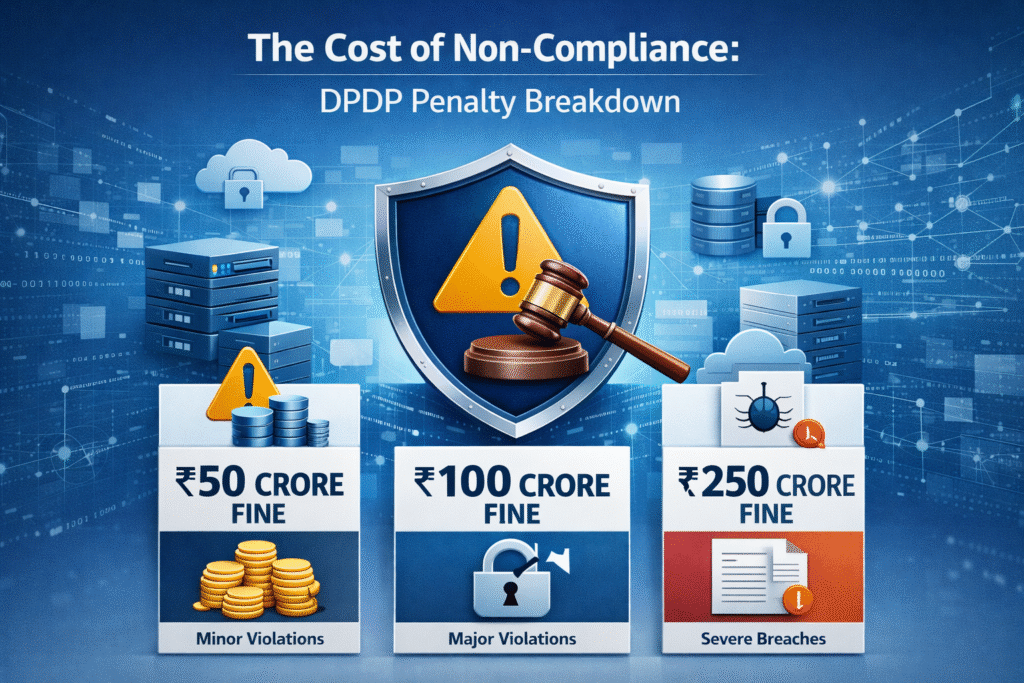
If an organization does not implement reasonable safeguards and a breach occurs, penalties can reach ₹250 crore.
Importantly, this exposure is not limited to dramatic cyberattacks. It also covers:
Misconfigured databases
Weak access controls
Poor internal security practices
Vendor or processor failures
In other words, the law evaluates outcomes rather than excuses.
Consent Violations Carry Serious Consequences
Consent forms the legal foundation of data processing under the DPDP Act. When consent mechanisms are unclear, misleading, or invalid, the penalties escalate quickly.
Violations related to consent can attract penalties of up to ₹200 crore.
This includes situations where:
Consent is bundled across unrelated purposes
Users are not clearly informed
Withdrawing consent is intentionally difficult
Data is used beyond the stated purpose
Consent failures are not treated as technical errors. Instead, they are viewed as violations of user autonomy.
Ignoring User Rights Is No Longer Safe
The DPDP Act gives individuals enforceable rights over their personal data. These rights include the ability to:
Access information
Correct inaccuracies
Withdraw consent
Raise grievances
Failure to respect or operationalize these rights can result in penalties of up to ₹50 crore.
Practically speaking, this means:
Ignored emails create risk
Slow grievance handling creates risk
Poor internal coordination creates risk
User rights are now operational obligations, not policy statements.
Children’s Data: A Zero-Tolerance Zone
The DPDP Act places heightened responsibility on organizations that process children’s personal data.
Non-compliance in this area attracts strict scrutiny, particularly when:
Data is used for tracking or profiling
Consent is improperly obtained
Safeguards are weak or absent
The underlying message is clear. Harm involving children is treated as aggravated harm.
No “Small Company” Discount
A common misconception is that startups or smaller businesses face lower risk under the DPDP Act.
They do not.
The law does not provide exemptions based on:
Revenue
Headcount
Stage of growth
If an organization processes personal data, the obligations apply. Penalties scale with the violation itself, not with sympathy for company size.
What Can Reduce Penalty Exposure
Although the penalties are serious, the DPDP Act does account for responsible behavior.
Authorities may consider mitigation when organizations can demonstrate:
Reasonable security safeguards
Documented compliance efforts
Prompt and transparent breach responses
Cooperation with regulators
Clear communication with affected users
In this context, governance matters. Documentation, audits, and internal controls are not administrative overhead. They serve as evidence of intent and effort.
Penalties Are Only One Part of the Cost
Financial penalties represent just one dimension of non-compliance.
Organizations also face:
Loss of user trust
Contractual issues with partners
Increased regulatory scrutiny
Long-term reputational damage
For data-driven businesses, trust erosion often proves far more expensive than any fine.
Final Thought
The DPDP penalty framework is not designed to surprise compliant organizations. It is designed to penalize those who ignore clear responsibilities.
Today, the cost of non-compliance is measurable, enforceable, and public.
In the DPDP era, the real question is no longer whether compliance is expensive.
The real question is whether non-compliance is survivable.