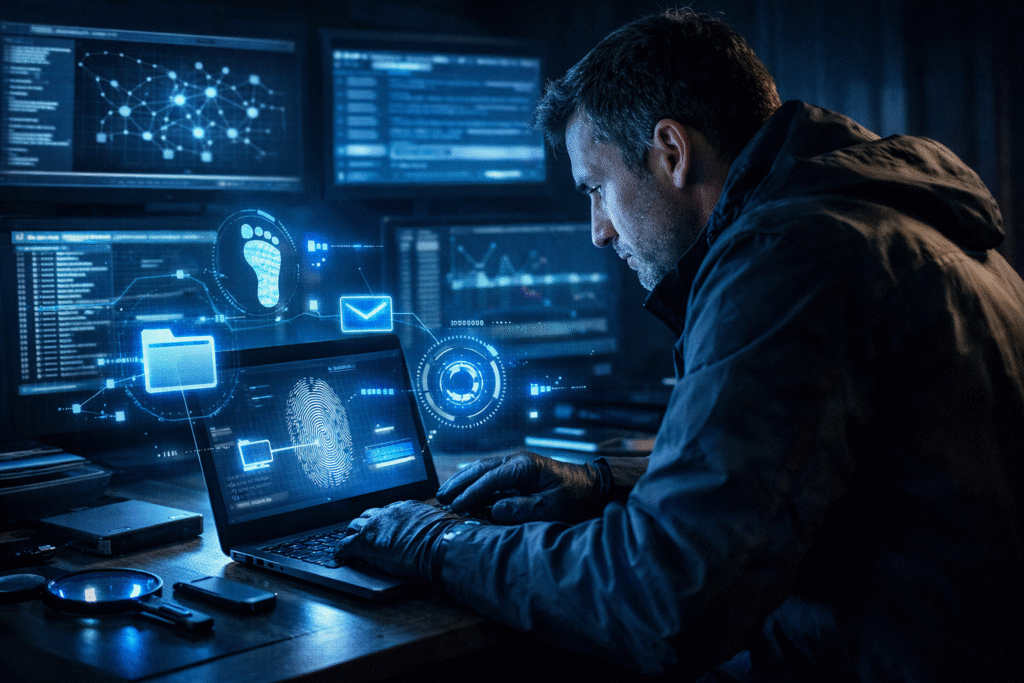
If you ask someone how crimes are usually solved, most people still picture the same things—fingerprints, CCTV footage, maybe witnesses being questioned. That’s how investigations have been shown for years.
But a lot has changed.
Today, many crimes don’t leave behind physical clues in the usual sense. Instead, they leave traces inside devices—phones, laptops, servers, and online accounts. Messages, login activity, transaction history… all of it becomes part of the story.
This is where cyber forensics comes in.
Where the Investigation Often Begins
In many cases, nothing looks obvious at the start.
There might be a complaint about fraud, unauthorized access, or suspicious activity. On the surface, there’s no clear evidence—just a device, an account, or a system that something happened to.
Investigators usually begin by looking at the devices connected to the incident.
It could be a laptop, a mobile phone, or even a company server. At first glance, it’s just data—files, folders, logs. Nothing that clearly explains what went wrong.
But that’s where the real work begins.
Looking for Small Clues in Digital Data
Unlike physical evidence, digital evidence isn’t always visible.
It could be something as simple as a login record. Or a file that was opened at a specific time. Even a deleted message can sometimes leave behind traces.
Individually, these details don’t say much.
But when investigators start connecting them, a pattern slowly forms.
Building the Timeline
One of the most useful parts of cyber forensics is putting events in order.
For example, someone logs into an account. A few minutes later, files are accessed. After that, money is transferred or data is copied.
When these actions are arranged step by step, the situation starts to make more sense.
It’s a bit like piecing together a story from scattered fragments.
Tracing Where the Activity Came From
Another important step is figuring out where certain actions originated.
Investigators may look at things like IP addresses, device information, or login locations. These details don’t always directly point to a person, but they help narrow things down.
Sometimes the same device shows up in multiple places. Sometimes an account is accessed from an unusual location.
These small inconsistencies often lead to bigger discoveries.
Why Investigators Don’t Touch the Original Data
One thing that surprises many people is how carefully digital evidence is handled.
Even turning on a device can change certain records. Because of that, investigators usually don’t work directly on the original system.
Instead, they create an exact copy and examine that.
It may seem like an extra step, but it helps ensure that the original data remains unchanged—something that becomes very important if the case goes to court.
When Deleted Data Isn’t Really Gone
People often assume that once something is deleted, it disappears completely.
That’s not always true.
In many cases, deleted files or messages can still be recovered, especially if they haven’t been overwritten. This is one of the reasons cyber forensics can uncover details that someone thought were gone.
Why Cyber Forensics Matters More Today
As more activities move online, crimes are leaving behind digital traces instead of physical ones.
Fraud, identity theft, unauthorized access—many of these cases rely heavily on digital evidence. Without cyber forensics, it would be difficult to understand how these incidents actually happened.
In some investigations, digital data becomes the most important piece of evidence.
Challenges Along the Way
Of course, the process isn’t always simple.
Devices can contain huge amounts of data, and finding what matters can take time. Some attackers also try to hide their activity or use tools that make tracing more difficult.
And sometimes the data isn’t in one place—it may be spread across multiple systems or even different countries.
Final Thoughts
Cyber forensics doesn’t always involve dramatic moments. Most of the time, it’s a slow process of examining details, connecting pieces, and building a clear picture from scattered data.
But that quiet work often makes a big difference.
As more of our lives move into digital spaces, understanding what happened in a case increasingly depends on the traces left behind in those systems.