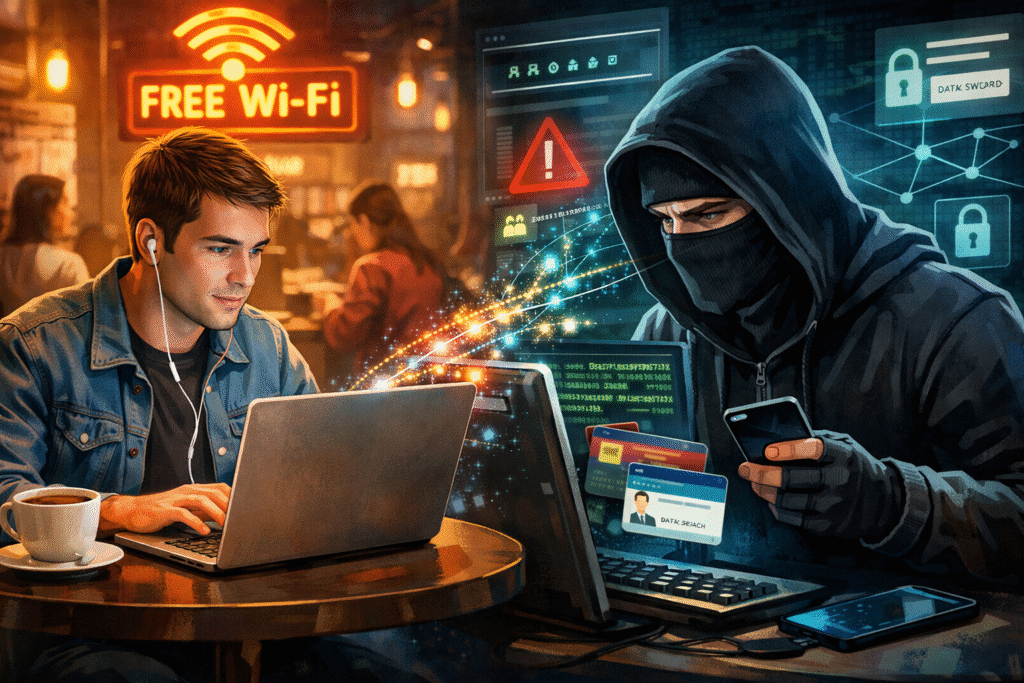
This topic came up after a casual conversation with a client.
He asked, “Is public Wi‑Fi really that dangerous? I use it every day.”
The short answer is yes. The long answer is what you’re reading now.
Public Wi‑Fi itself is not evil. The problem is that it is shared, open, and mostly unmanaged. That combination makes it attractive to people who know how to quietly take advantage of it.
What Actually Happens on Public Wi‑Fi
When you connect to public Wi‑Fi, your device becomes part of a group. Everyone else connected is on the same digital road. In many cases, there are no proper barriers between users.
Most people assume hacking requires advanced tools and dramatic actions. In reality, many attacks on public Wi‑Fi are boring, silent, and invisible.
No pop‑ups. No warnings. No alerts.
How Hackers Take Advantage
Watching Traffic Go By
Think of public Wi‑Fi like a crowded room where people talk loudly. If conversations are not encrypted, anyone nearby can listen.
Hackers use basic tools to observe data moving through the network. If a website or app does not protect information properly, login details and messages can be exposed.
Fake Networks That Look Legit
This happens more often than people realize.
Someone creates a Wi‑Fi network with a familiar name — cafe, airport, hotel. People connect without checking. From that point on, all activity flows through the attacker’s system.
Nothing breaks. Everything works. That’s why it’s dangerous.
Session Access Without Passwords
Many users think passwords are the only thing hackers want.
Not true.
Sometimes, attackers copy active login sessions. This allows them to open accounts directly, without ever knowing the password.
The user stays logged in. The hacker logs in too.
Small Tricks That Lead to Bigger Problems
Public Wi‑Fi is often used to push fake update messages or suspicious links. One careless click is enough to install software that keeps running quietly in the background.
Over time, this can expose emails, saved passwords, documents, and even client data.
What Information Is Usually Targeted
Hackers are not always looking for something dramatic. They focus on what is easy and reusable:
- Email access
- Social media accounts
- Payment apps
- Saved browser passwords
Work files For businesses
this is where real damage begins.
Simple Habits That Reduce Risk
You don’t need to be paranoid. You just need to be careful.
Avoid banking or sensitive work on public Wi‑Fi.
Use mobile data when possible.
If you must use public Wi‑Fi, use a trusted VPN.
Don’t click update alerts on unknown networks.
Turn off auto‑connect and file sharing.
Update your device regularly.
These habits are boring, but they work.
Final Thought:
Public Wi‑Fi is convenient, and most people will continue using it. The goal is not to scare users, but to help them understand how easily data can be exposed.
At Nitin Digital, we see digital security as a habit, not a one‑time setup. Awareness and small decisions make the biggest difference.