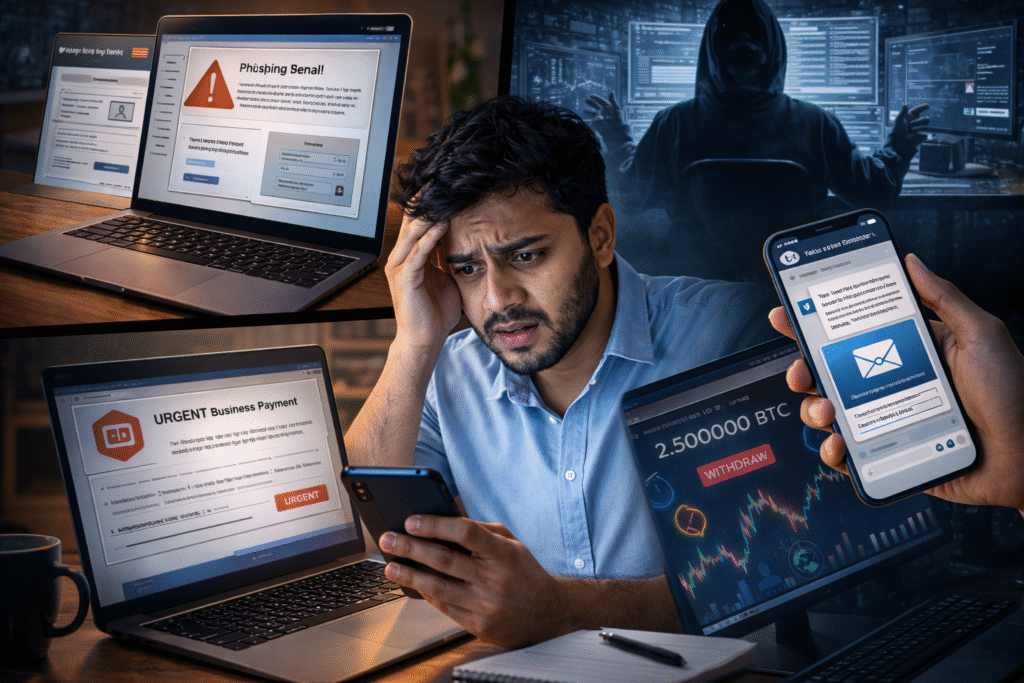
Not too long ago, many working professionals in India believed cyber scams mostly affected bank customers or people who were not very familiar with technology. Office employees and business professionals rarely imagined they would be attractive targets.
That idea has slowly changed.
Today, a large part of professional life happens online. Emails, digital payments, online meetings, and professional networking platforms have become routine. While these tools make work easier, they also give scammers new ways to approach potential victims.
And professionals are often exactly the people they want to reach.
How Scammers Usually Reach Professionals
The interesting thing about many cyber scams is that they rarely start in a dramatic way.
Sometimes it is just a normal-looking email. Other times it might be a LinkedIn message, a WhatsApp text, or even a quick phone call. At first, the communication often appears routine, something that could easily be part of everyday work.
Because professionals deal with dozens of messages during a workday, one more message does not usually raise suspicion.
That moment of familiarity is what scammers depend on.
Lorem ipsum dolor sit amet, consectetur adipiscing elit. Ut elit tellus, luctus nec ullamcorper mattis, pulvinar dapibus leo.
Phishing Emails in the Workplace
One of the most common situations involves phishing emails.
A professional might receive a message that appears to come from a bank, a cloud service, or even a company colleague. The email may mention a security alert or ask the recipient to verify account details.
The message usually includes a link.
Clicking that link may open a page that looks almost identical to a real login screen. But the page is fake, and any information entered there goes directly to the scammers.
In a busy work environment, it only takes one quick click for the problem to begin.
Fake Recruiters on Professional Platforms
Another scam that many professionals encounter involves fake recruiters.
LinkedIn has made networking and job searching much easier, but scammers have also started using the platform to approach potential victims.
The conversation often begins with a friendly message praising someone’s experience or skills. The recruiter may mention a job opening that seems attractive and relevant.
At first the interaction feels genuine.
Later, however, the recruiter may mention a training fee, registration payment, or equipment cost required before the role begins. That is usually where the scam becomes clear.
Business Email Impersonation
Some scams are more subtle.
Instead of pretending to be recruiters, scammers may impersonate company executives or business partners. The message might ask an employee to make an urgent payment or share sensitive documents.
Since the request appears to come from someone within the organization, employees sometimes act quickly without verifying it.
These incidents can lead to serious financial losses for companies.
Investment and Side-Income Traps
Professionals are also frequent targets for investment scams.
Messages promising quick profits, cryptocurrency opportunities, or easy side income appear regularly on messaging apps and social platforms.
At first the offers can look convincing. Some victims even receive small payouts early on, which builds confidence in the scheme.
Eventually the scammers encourage larger investments.
That is usually when the money disappears.
Why Professionals Sometimes Fall for These Scams
From a distance, these scams might seem easy to spot. But real situations are often more complicated.
Professionals are busy. Messages arrive constantly, and decisions often have to be made quickly. Under those conditions, it is easy to trust a message that appears to come from a familiar source.
Scammers understand this perfectly.
They design their messages to look ordinary enough that they blend into everyday communication.
A Few Signs That Should Raise Questions
There are a few simple things professionals can keep in mind.
Unexpected requests for urgent payments are always worth double-checking. Messages asking for login credentials or personal information should also be treated carefully.
Another detail to watch for is unusual email addresses or links that lead to unfamiliar websites.
Taking a moment to verify a message can prevent a much larger problem.
Staying Safe in a Digital Work Environment
Protecting yourself online does not always require complicated tools.
Often it begins with small habits. Checking the sender of an email, confirming unusual requests with colleagues, and enabling two-factor authentication can make a significant difference.
Organizations are also beginning to invest more in cybersecurity awareness, helping employees recognize suspicious activity before it causes damage.
Final Thoughts
As work continues to move into digital spaces, cyber scams are likely to evolve as well. Professionals in India are increasingly becoming targets because of the access they have to valuable information and financial systems.
Staying aware of common tactics can help people avoid becoming victims.
Sometimes, the most effective protection is simply pausing for a moment before trusting a message that appears unexpectedly.