
A client once called me, genuinely embarrassed, saying “Sir, it’s just a mixer grinder, maybe I shouldn’t waste your time over ₹3,000.” He’d bought it, and it stopped working in ten days. The shop kept telling him to “come back next week.” Three months of “next week” later, he finally gave up and called me. His case shows why so many people never learn how to file a consumer complaint in India. The law actually sits squarely on their side.
Here’s the thing — it was never about the ₹3,000. It was about a seller who knew most people just won’t bother fighting for it.
And honestly, that’s most of us. A product breaks. A builder delays possession for the fourth time. An insurer rejects a claim for no real reason. Customer care just reads from a script. And we let it go. We don’t accept it because we’re okay with it. We accept it because nobody ever really explained how the system works, or that ordinary people, not just lawyers, can actually use it.
So let’s fix that today.
Wait, Am I Even a “Consumer” Under the Law?
Yes, probably. Suppose you bought something or paid for a service, for yourself, not for resale. Then the Consumer Protection Act, 2019 treats you as a consumer with real, enforceable rights. It doesn’t matter if it was a mixer grinder, a flat, a mobile recharge, or a surgery at a private hospital.
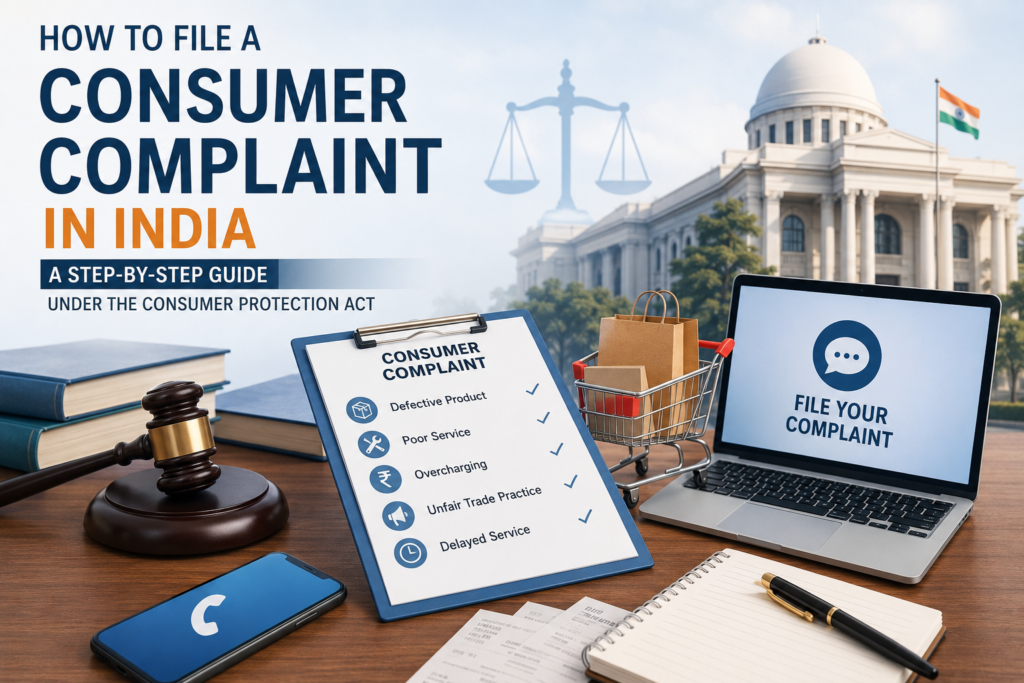
You can file a complaint for things like:
A defective product, or one that doesn’t match what the seller promised. A service the company simply never delivered properly. Ads that lied to you, even a little. Sellers charging more than the MRP. Hidden charges that showed up only at the billing stage. A builder sitting on your possession date for years. Banks, insurance companies, or telecom operators dragging their feet on something they clearly owe you.
If any of that sounds familiar — and I’d guess it does — you already have a case. You just haven’t used it yet.
Step One: Don’t Skip the Boring Part — Write to Them First
Before any legal notice, before any commission, send a plain written complaint. Email works best because WhatsApp messages have a habit of disappearing into “seen but ignored” territory, and email gives you a proper timestamp.
Say what happened, what you paid, and what you want — refund, replacement, repair, whatever it is. Companies often fix things fast once they realize you won’t just call, complain, and forget about it. A written trail changes their tone almost instantly.
If they still don’t respond, or respond with the customer-service equivalent of a shrug, move on to the next step.
Step Two: A Legal Notice Usually Gets Things Moving
There’s something about a notice on an advocate’s letterhead that makes companies suddenly find their manners. It’s not magic — it just signals that you’re serious enough to actually follow through. A good chunk of disputes settle right after this step. Most businesses would rather resolve things quietly than deal with an actual case.
It’s not compulsory, but I’d still recommend it. It rarely hurts, and it often works.
Step Three: Where to File Your Consumer Complaint in India
India splits this into three levels, based on how much money is at stake. The Consumer Protection Act, 2019 sets out this structure:
District Commission handles claims up to ₹50 lakh. State Commission takes over between ₹50 lakh and ₹2 crore. Anything above ₹2 crore goes to the National Commission.
One thing people don’t realise — you can usually file where you live or work, not just where the company sits. That’s a small but genuinely useful thing about this law. You don’t need to travel across the country to fight for what’s rightfully yours.
Step Four: What You Actually Need to File
This part is far less scary than people assume. You’ll need a written complaint laying out what happened, in order. Your bill or purchase proof. Any emails, screenshots, or messages you exchanged with them. A copy of the legal notice, if you sent one. And a clear ask — what you actually want as a resolution.
You don’t strictly need a lawyer for smaller, simpler complaints. Lawmakers designed the process so an ordinary person could file it themselves. But bring in real money, or a large company with its own legal team, and things change. Having someone who knows how to draft and argue the case properly stops being optional.
Step Five: What Happens Once You’ve Filed
The commission sends a notice to the other side, and they have to respond. No more ignoring you. Both sides present their evidence. Consumer cases generally move faster than regular court cases. Some wrap up in a few months; more complicated ones take longer, especially if the other party keeps contesting every point.
If it goes your way, you could get a refund, a replacement, or compensation for what you went through. In cases of clearly unfair practices, the commission can even slap on additional costs against the company.
One Last Thing
Filing a complaint isn’t about being “that person.” It’s about not letting a company bank on your silence. My client with the mixer grinder eventually got a full refund, plus a bit extra for the runaround. It wasn’t life-changing money. By then, it wasn’t really about the money at all. He just wanted the seller to take him seriously.
Knowing how to file a consumer complaint in India puts the power back in your hands, whether the amount at stake is ₹3,000 or ₹3 lakh.
If something like this is happening to you right now, don’t just sit on it. And if you’re unsure whether your situation actually qualifies, or how to word a legal notice properly, get a quick opinion before you decide your next move. It’s a lot easier to do this right the first time than to fix it later.