
In-House vs Outsourced DPO Which Is Right for Your Business Size
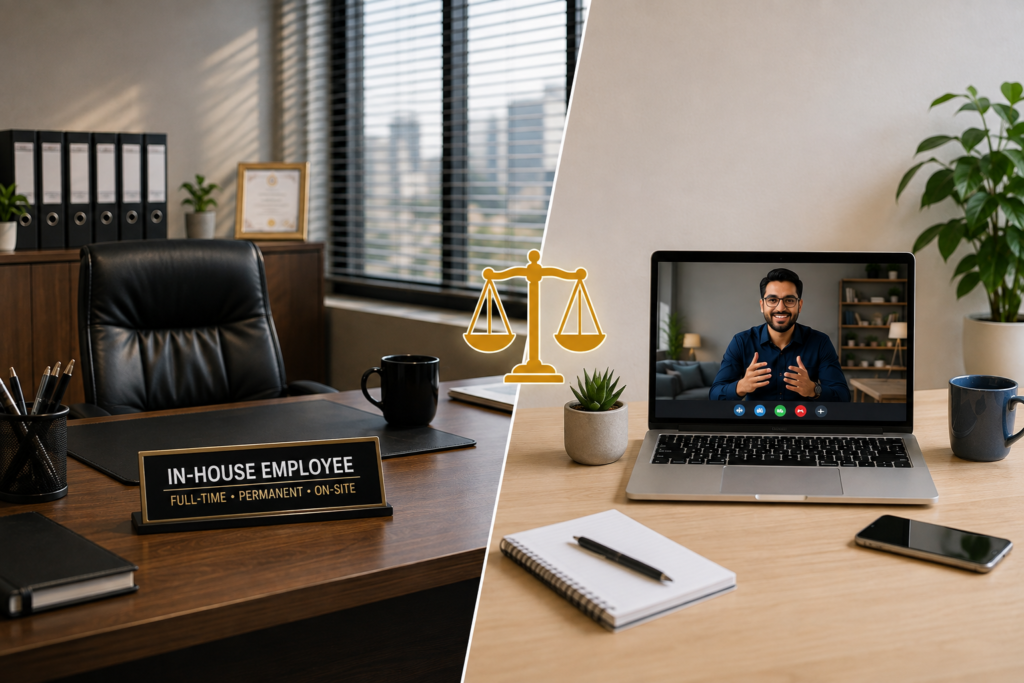
A FinTech founder asked me a straightforward question during a consultation last month: “Do I need to hire someone full-time for this, or is there another way?” He’d just found out his company needed a Data Protection Officer under the DPDP Act. The first quote he’d gotten — from a recruiter, for a full-time in-house hire — was more than his entire compliance budget for the year.
He’s not alone in this. Most founders and CXOs I speak with assume “appointing a DPO” automatically means adding a full-time senior hire to the payroll. It doesn’t. The DPDP Act requires certain businesses to designate a Data Protection Officer, but the law doesn’t dictate that this person has to be a full-time employee sitting in your office. You have a real choice here. The right answer depends heavily on your business size, data volume, and how mature your compliance function already is.
What a DPO Actually Does Under the DPDP Act
Before comparing the two models, it helps to be clear on what the role covers. A DPO acts as the point of contact between your organization and the Data Protection Board. This person oversees your data processing practices, handles grievances from data principals (your customers or users), and ensures your privacy policies and consent mechanisms actually hold up under scrutiny.
This isn’t a checkbox role. A DPO needs to understand your business’s specific data flows — what you collect, why, where it’s stored, who has access, and what happens if something goes wrong. That holds true whether the person sits in your office five days a week or works with you through a structured outsourced engagement.
When an In-House DPO Makes Sense
An in-house DPO is worth the investment when your business meets a few specific conditions. Say you’re processing large volumes of sensitive personal data daily — think a hospital network, a large FinTech platform, or an enterprise handling millions of user records. Having someone embedded in your operations, attending internal meetings, and available at a moment’s notice becomes genuinely necessary at that scale.
It also makes sense once privacy touches nearly every department in your organization — product, engineering, HR, marketing, customer support. Someone needs to be present daily to catch issues before they become violations. At that scale, the cost of a full-time DPO is usually smaller than the operational risk of not having one.
When Outsourced DPO Services Make More Sense
For most startups, SMEs, and even mid-sized companies, an outsourced DPO is the more practical choice. Cost isn’t the only reason. Here’s why:
You get senior-level expertise without a senior-level salary. A qualified in-house DPO with real DPDP and privacy law expertise commands a significant salary. An outsourced arrangement gives you access to that same level of expertise at a fraction of the cost, because you’re paying for the function, not a full-time headcount.
Your data processing volume often doesn’t justify a full-time role. Suppose your business collects customer data but isn’t processing it at massive scale every single day. A full-time DPO will spend a large portion of their week with genuinely little to do in that case. An outsourced DPO scales their involvement to your actual needs — more support during audits or incidents, lighter touch during steady periods.
You avoid the hiring and retention problem entirely. DPDP-qualified privacy professionals are still a small talent pool in India. Hiring one is its own ongoing challenge, and retaining them is harder still. An outsourced arrangement sidesteps this. You get continuity without the recruitment cycle repeating every time someone leaves.
You get independence built into the role. A DPO is meant to act with a degree of independence from internal business pressures, flagging risks even when they’re inconvenient. An outsourced DPO sits slightly outside your internal hierarchy by design. That distance can make independence easier to maintain in practice.
A Simple Way to Decide
Ask yourself these questions if you’re unsure which model fits your business:
- Do you process sensitive personal data (health records, financial data, biometric data) at high daily volume?
- Does your organization have more than a few hundred employees or a complex, multi-department data ecosystem?
- Do you already have an internal legal or compliance team that a DPO would need to work alongside daily?
An in-house DPO is worth seriously considering if you answered yes to most of these. Most startups, SMEs, and growing businesses I work with answer no to most of these — and for them, an outsourced DPO gives full compliance coverage without the overhead of a full-time hire.
What This Looked Like for the FinTech Founder
Back to the founder from the start of this post. We walked through his actual data processing volume, team size, and current compliance maturity together, and the answer became clear. He didn’t need a full-time hire. He needed structured, ongoing DPO support that could scale with him as his company grew, with the flexibility to increase involvement during audits or if a regulatory issue came up.
Our outsourced DPO services are built around exactly this model — independent compliance oversight, regulatory liaison support, breach advisory, and governance monitoring. A growing business shouldn’t have to commit to a full-time senior salary before it’s actually necessary.
Are you trying to figure out whether your business needs a DPO at all? Not sure which model fits your current stage? That’s exactly the kind of question worth working through in a free consultation before you commit to either path.